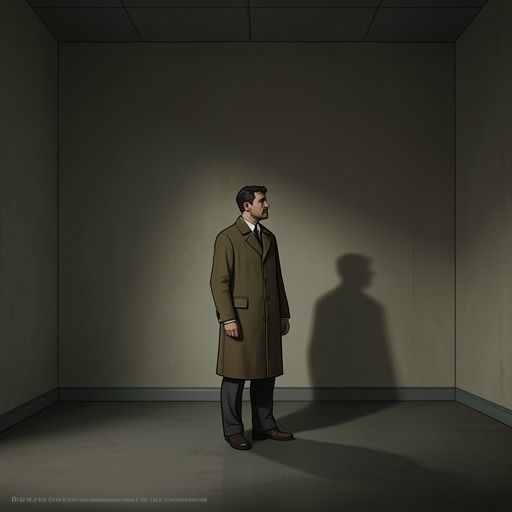
“Better to do nothing than to contribute to the invention of formal ways of rendering visible that which Empire already recognizes as existent”
The Parallax View“Better to do nothing than to contribute to the invention of formal ways of rendering visible that which Empire already recognizes as existent” is a deliberately provocative expression about the limits of political participation. It warns that activity presented as resistance may instead help the existing system organize, recognize, and absorb what it claims to oppose.
Context and Argument
The expression appears in a critique of Critchley’s advocacy of modest, local practical action. The passage invokes Alain Badiou’s thesis to challenge the assumption that doing something is necessarily more emancipatory than doing nothing. Its target is not action in itself, but localized interventions whose ultimate effect is to make the system run more smoothly, including the provision of space for the Multitude of new subjectivities.
The statement sharpens the passage’s distinction between effective political change and participation that leaves the terms of power intact. It describes a trap in which the demand to act becomes its own justification: people intervene, academics take part in what the author calls meaningless debates, and those in power welcome even critical participation if it draws people into dialogue and breaks their silence. Under these conditions, activity can reassure the system that opposition remains within channels it already recognizes.
Pseudo-Activity and Withdrawal
The expression’s stark opening gives withdrawal a political force. The passage argues that the danger is not passivity but pseudo-activity: the urge to be active and participate can conceal the emptiness of what is being done. Stepping back is therefore presented as difficult precisely because the prevailing demand to act can turn every intervention into another means of sustaining the existing order.
The warning is carefully conditional. It does not establish that every local intervention is futile; it asks whether acts of resistance actually threaten power or instead supply material that keeps its machinery moving. The test is not activity versus inactivity in the abstract, but whether an intervention exceeds the system’s capacity to recognize and incorporate it.
Revolution as Must
The surrounding argument extends the critique from everyday participation to revolutionary change. The anxious expectation that capitalism will continue indefinitely, coupled with a desperate demand to do something to transform it, is described as false when revolution becomes a moral obligation. Drawing on Bernard Williams’s distinction between ought and must, the passage presents authentic revolution not as an ideal people ought to pursue despite inertia, but as a Must: something they cannot but do.
In this context, the expression is not a general endorsement of inaction. It marks the difference between waiting for change as an abstract duty and recognizing a historical situation in which action becomes unavoidable. Political force, on this account, cannot be secured simply by multiplying acts of participation; it depends on whether a genuine site for emancipatory change exists and whether the act answers to that necessity rather than to the demand to appear active.